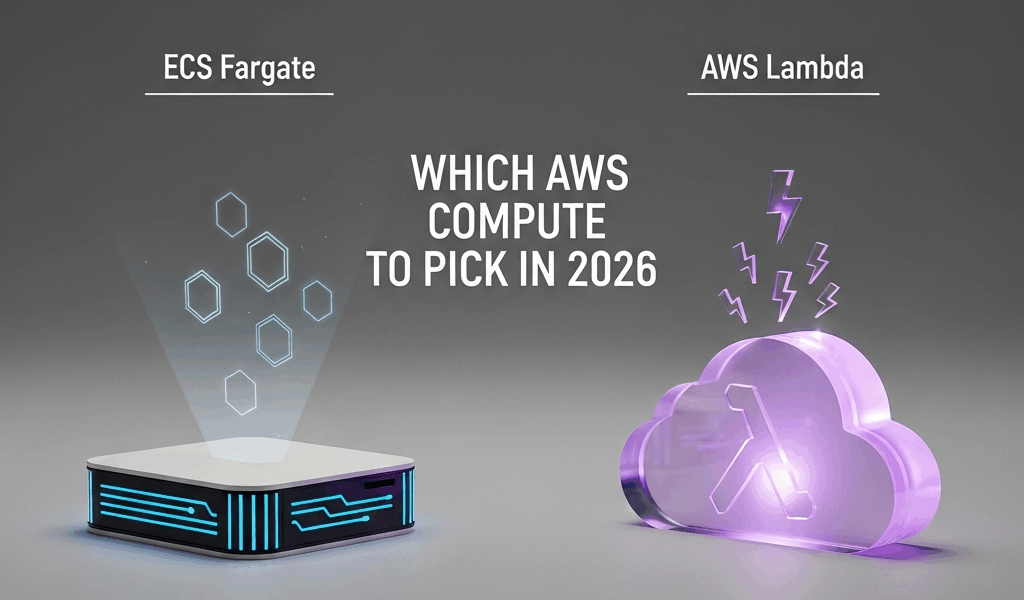
ECS Fargate vs Lambda — Which AWS Compute to Pick in 2026
The ECS Fargate vs Lambda debate has developed a learning curve from hell with all the outdated comparison articles flying around. As someone who’s been running production workloads on both services since 2019, I learned everything there is to know about how AWS pricing shifts can quietly wreck your infrastructure budget. And there’s one change from August 2025 that most teams still haven’t fully accounted for. If you’re working off a 2024 comparison, you’re making decisions with the wrong numbers. Let’s fix that.
This article includes affiliate links. We may earn a commission at no extra cost to you.
The 2025 Change That Rewrote the Lambda vs Fargate Math
For most of Lambda’s existence, the INIT phase was free. Cold start happened — AWS spun up a new execution environment, loaded your runtime, ran initialization code — and you paid nothing for that time. You only got billed once your handler actually started executing. That was a real subsidy, and it made Lambda look cheaper than it actually was for workloads with heavy initialization logic.
August 2025, AWS changed that. Lambda now bills for INIT phase duration at the same rate as regular execution: $0.0000166667 per GB-second on x86, or $0.0000133334 per GB-second on ARM64. Doesn’t sound like much. For a lightweight Go function with a 50ms cold start, it genuinely isn’t.
For a Java Spring Boot application without SnapStart? Whole different story.
Honestly, I should have started here. Everything downstream in this article depends on understanding that the INIT billing change isn’t a footnote — it’s the headline. Don’t make my mistake: I didn’t audit our Java-based Lambda functions immediately after the rollout. Spent three weeks watching our Lambda line item climb before I figured out why. Turned out one function — a Python data processing job pulling in pandas, numpy, and a handful of ML inference libraries — had an INIT phase averaging 4.2 seconds at 1024MB. Previously free. After August 2025, that’s 4.3 GB-seconds of billable INIT per cold start. At scale, that’s not rounding error territory.
The impact breaks down pretty differently by runtime:
- Python with heavy packages — pandas, scikit-learn, boto3 bundles, PyTorch inference layers. INIT phases of 2–8 seconds are common. Cost increase of 20–50% for workloads that cold start frequently.
- Java without SnapStart — JVM startup plus Spring context initialization can push INIT to 8–15 seconds. This is where the billing change bites hardest. Easily 40–60% more expensive than pre-August 2025 modeling suggested.
- Node.js with large dependency trees — moderate impact, typically 10–20% increase depending on bundle size.
- Go and Rust — minimal impact. INIT phases under 100ms are normal. The billing change barely moves the needle.
- Java with SnapStart — SnapStart restores a cached snapshot of the initialized execution environment, so the billable INIT phase is essentially eliminated. This partially offsets the August 2025 change for Java specifically.
The practical consequence: Lambda’s total cost of ownership went up for any workload where cold starts are frequent and initialization is heavy. Always-on services — things that need warm instances to stay responsive — now sit much more favorably next to Fargate’s flat, predictable pricing. The break-even point moved. Significantly.
When Lambda Still Wins in 2026
Lambda isn’t broken. It’s just more expensive for specific patterns than it was before August 2025. For the right workload profile, it’s still the correct choice — sometimes by a wide margin.
Bursty, Event-Driven Workloads
Lambda’s superpower has always been scaling to zero. You pay nothing when there’s no traffic. Fargate tasks, by contrast, bill by the second for vCPU and memory — a 0.25 vCPU / 0.5GB task sitting idle costs roughly $9.73/month on x86. Not catastrophic on its own, but across dozens of mostly-quiet microservices, it adds up fast.
That’s what makes Lambda endearing to us event-driven architects. A function triggered by an S3 upload processes a file in 800ms, scales from zero to 500 concurrent executions during a data ingestion spike, then drops back to nothing when it’s done. Fargate can’t touch that elasticity without significant pre-configuration — auto-scaling policies, minimum task counts, warm-up time. For genuinely bursty patterns, Lambda still wins cleanly.
Low Request Volume — Under 1M Requests Per Month
The Lambda free tier covers 1 million requests and 400,000 GB-seconds of compute per month, every month. For hobby projects, internal tooling, or low-traffic APIs, Lambda might cost you literally nothing. A Fargate task costs something even when it’s doing nothing.
Below about 500,000 requests per month for most workloads, Lambda is cheaper — even factoring in the new INIT billing — provided your functions aren’t initializing for multiple seconds every invocation. Keep deployment packages lean, initialize only what you need in the global scope, and the cost advantage holds.
Short-Lived Functions With Lightweight Runtimes
A Go function handling webhook validation. A Rust-based authorizer sitting in front of API Gateway. A Node.js function parsing a JSON payload and writing to DynamoDB. These run in 50–200ms, have INIT phases under 100ms, and scale to zero between spikes. Lambda is the right tool — full stop. The August 2025 billing change adds maybe $0.003 per thousand cold starts to these workloads. Completely manageable.
Java With SnapStart Enabled
SnapStart — available for Java 11 and later on Lambda — takes a snapshot of the initialized execution environment and restores from it on cold starts instead of re-running initialization code. Cold start latency drops from 8–12 seconds to typically under 1 second. The billable INIT duration? Essentially zero. You’re restoring a snapshot, not running initialization.
If you’re running Java on Lambda in 2026, enabling SnapStart is no longer optional. It’s the difference between Lambda being cost-competitive and Lambda being the most expensive thing in your compute portfolio. Enable it, test it, stop paying for JVM startup.
When Fargate Wins in 2026
Fargate has quietly gotten more compelling — and it’s not just about Lambda’s INIT billing change. AWS has kept investing in Graviton ARM64 pricing for Fargate, and the gap between ARM64 and x86 is now consistently 20% in favor of ARM64. That discount compounds nicely with the right workload profile.
Steady-State Traffic With Predictable Load
If your service runs at reasonably consistent traffic — say a B2B SaaS API processing requests from 9am to 6pm on weekdays — Fargate’s flat compute model is simply more efficient. No per-invocation overhead. No concurrency limit anxiety. You provision 0.5 vCPU and 1GB of memory on ARM64, run your application, and pay approximately $16.24/month for that task. That’s it.
At 100,000 requests per day with an average execution time of 300ms at 512MB, Lambda runs roughly $45–65/month on the same workload after INIT billing — depending on cold start frequency. Fargate wins. Not by a little.
Long-Running Processes
Lambda has a hard 15-minute execution limit. Anything longer than that simply doesn’t fit. Video transcoding pipelines, large file processing jobs, long-polling workers, database migration scripts — these belong on Fargate. No architectural gymnastics to chunk work into sub-15-minute segments. Just run the process to completion.
Applications With Heavy Startup Logic
This is where the August 2025 billing change has the biggest real-world impact on architecture decisions. If your application loads a 500MB model file on startup, initializes a connection pool, and warms up an in-memory cache — that initialization cost is now billable on Lambda every single cold start. On Fargate, initialization happens once when the task starts, and you pay for it exactly once. After that, every request hitting a warm Fargate task carries zero initialization overhead in your billing.
ML inference services, applications with heavy ORM initialization, services pre-loading large configuration sets — these all belong on Fargate now more than they ever did before August 2025.
ARM64 Graviton Pricing Makes the Numbers Work
Fargate on ARM64 runs at $0.03238 per vCPU-hour and $0.00356 per GB-hour in us-east-1, as of Q1 2026. That’s 20% cheaper than x86 equivalents. Most containerized workloads run without modification on ARM64 — change the platform in your task definition to linux/arm64, update your ECR image build to target ARM, and you’re done. For greenfield services, there’s honestly no reason not to run ARM64 on Fargate today.
The Cost Comparison Table Nobody Shows You
Most cost comparisons show Lambda’s compute cost next to Fargate’s compute cost and call it done. They miss Lambda’s per-request charge ($0.20 per million requests), they miss the INIT billing, and they miss that Lambda functions at medium-to-high volume often need provisioned concurrency to avoid cold starts — which costs money even sitting idle.
Here are three scenarios with current 2026 pricing, x86 for both services. Lambda assumes Python runtime with a 2-second INIT phase — modest, not worst case — and 512MB memory. Fargate assumes a 0.25 vCPU / 0.5GB task. Average request duration is 200ms.
Scenario A — Low Traffic — 10,000 Requests Per Day (300K/Month)
- Lambda compute cost — 300,000 requests × 200ms × 512MB = 30,720 GB-seconds = $0.51
- Lambda request charge — $0.06
- Lambda INIT cost — Assuming 5% cold start rate (15,000 cold starts) × 2s × 512MB = 15,360 GB-seconds = $0.26
- Lambda total — approximately $0.83/month
- Fargate — 1 task running 24/7 — 0.25 vCPU × 720 hours × $0.04048 + 0.5GB × 720 × $0.004445 = $7.31 + $1.60 = $8.91/month
Winner at this volume — Lambda, by a wide margin. Even with INIT billing, a persistent Fargate task is 10x more expensive at low traffic. Scale to zero wins here, no contest.
Scenario B — Medium Traffic — 100,000 Requests Per Day (3M/Month)
- Lambda compute cost — 3M requests × 200ms × 512MB = 307,200 GB-seconds = $5.12
- Lambda request charge — $0.60
- Lambda INIT cost — Assuming 1% cold start rate (30,000 cold starts) × 2s × 512MB = 30,720 GB-seconds = $0.51
- Lambda total — approximately $6.23/month
- Fargate — 1 task, ARM64 — 0.25 vCPU × 720 × $0.03238 + 0.5GB × 720 × $0.00356 = $5.83 + $1.28 = $7.11/month
Winner — Lambda, narrowly. But watch what happens with Java and a 10-second INIT phase instead of Python at 2 seconds. Lambda’s INIT cost alone jumps to $2.55, pushing Lambda total to $8.27. Fargate wins at that point. This is exactly the break-even zone where runtime choice changes the correct infrastructure decision.
Scenario C — High Traffic — 1,000,000 Requests Per Day (30M/Month)
- Lambda compute cost — 30M × 200ms × 512MB = 3,072,000 GB-seconds = $51.20
- Lambda request charge — $6.00
- Lambda INIT cost — At this scale, most requests hit warm containers (0.1% cold start rate = 30,000 cold starts) × 2s × 512MB = $0.51
- Lambda provisioned concurrency to keep warm — Need approximately 50 concurrent executions provisioned. 50 × 720 hours × 512MB × $0.0000097 per GB-second = $12.64/month
- Lambda total — approximately $70.35/month
- Fargate — 3 tasks, ARM64, auto-scaled for load — 3 × ($5.83 + $1.28) = $21.33/month
Winner — Fargate, decisively. The provisioned concurrency cost alone accounts for a significant chunk of Lambda’s overhead at this scale. Three Fargate ARM64 tasks handling 1M requests per day cost less than a third of the Lambda equivalent — once you account for everything Lambda actually charges.
The break-even point, in practical terms, lands somewhere between 50,000 and 150,000 requests per day for typical web API workloads on Python or Java runtimes. Below that threshold, Lambda’s scale-to-zero advantage dominates. Above it, Fargate’s flat-rate compute becomes more economical — especially on ARM64, especially if your functions have non-trivial initialization logic.
The Decision Framework — Two Questions That Cut Through the Noise
After running both services across production workloads of varying shapes and sizes, I’ve reduced the decision to two questions. Apparently simple — actually sufficient:
- Does traffic scale to zero or near-zero regularly? If yes, Lambda. The scale-to-zero billing advantage is real and it’s large. No Fargate configuration makes a sleeping service free.
- What is your average INIT duration, and how often do you cold start? If your INIT phase exceeds 1 second and cold starts hit more than 0.5% of requests — model the INIT cost explicitly before choosing Lambda. The August 2025 billing change made this a required step, not optional.
For Java services specifically: enable SnapStart and re-run the numbers — it changes the answer. For Python services loading heavy ML libraries, containerizing on Fargate ARM64 might be the best option, as that workload profile requires predictable initialization cost. That is because paying once per task start beats paying per cold start at any meaningful scale. For lightweight Go or Rust functions processing async events: Lambda in 2026 is still the cleanest, cheapest solution available in the AWS ecosystem.
Both tools are good. The pricing is just different from what 2024 articles described. Run the actual numbers for your actual workload — the framework above gives you everything you need to do exactly that.


Leave a Reply